Carousels have long been a staple of amusement parks and fairs, captivating riders with their whimsical charm and timeless allure. While the traditional carousel is a familiar sight, its double-decker variant adds an extra layer of visual impact and mechanical intricacy. In this blog, we’ll explore the differences in the operating mechanisms between standard and double-decker carousels, highlighting what makes the latter a marvel of engineering and design.
The Classic Carousel Mechanism
Before delving into the complexities of the double-decker carousel, it’s essential to understand the basics of a standard carousel’s operation. Typically, a central pole supports the entire structure, with a platform attached where various ride-on animals or chariots are mounted. These figures are often suspended by rods connected to a rotating disc at the top, allowing them to move up and down as the carousel spins, simulating the motion of galloping.
The rotation is usually driven by an electric motor, with gears and a drive belt transferring motion to the platform. This system is relatively straightforward, enabling the carousel to provide joy with a simple yet effective mechanical design.
Elevating the Experience: Double-Decker Carousels
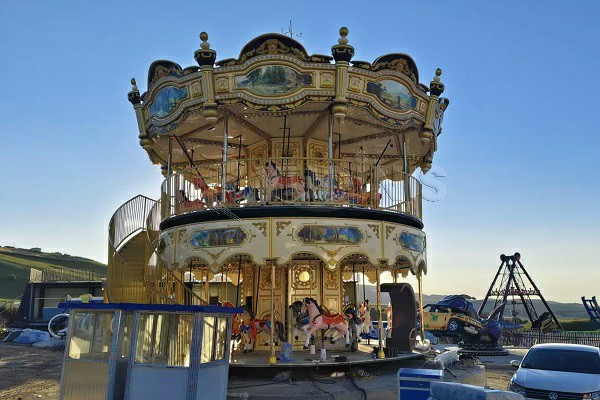
38 seats double decker carousel elevates the experience—quite literally—by introducing a second level of rideable figures. However, this addition is not just a matter of stacking another layer on top. The engineering challenges are significant, owing to the increased weight, the need for balanced distribution, and the complexity of moving parts.
The first difference lies in the support structure. Double-decker carousels require a more robust central pole and additional support beams to safely carry the weight of the upper deck. The load-bearing capacity must be carefully calculated to ensure stability and safety for all riders.
The Dual-Level Drive System
The heart of the two story carousel’s operating mechanism is its dual-level drive system. Unlike single-tier carousels, where one motor can suffice, Dinis mechanical ride double-deckers often employ multiple motors to maintain synchronous movement between levels. These motors are intricately synchronized to ensure that the upper and lower platforms rotate at consistent speeds, preserving the ride’s fluidity and grace.
Dynamic Movement and Synchronization
Another critical aspect is the dynamic movement of the ride figures. In a double-decker carousel, both levels need to be synchronized not only in rotation but also in the vertical bobbing of the animals. This requires a more complex system of cams and linkages to coordinate the rise and fall of figures on both decks.
Furthermore, the distribution of figures must be strategically planned to maintain balance. Given that the top deck is further from the central axis, the centrifugal forces at play necessitate careful engineering to prevent undue stress on the structure.
A Fusion of Art and Engineering
Double-decker carousels represent a fusion of art and engineering, offering not only a visually stunning ride but also a testimony to human ingenuity. The differences in their operating mechanisms—robust support structures, dual-level drive systems, and synchronized dynamic movement—set them apart from their single-story counterparts and provide an enchanting experience for riders of all ages.
As we admire the twirling lights and joyous music of these magnificent machines, it’s worth appreciating the intricate design and sophisticated mechanics that bring the magic of double-decker carousels to life.
Leave a Reply