A park that is still on paper has no reputation, no visitor data and no photographs. It has a business plan, a plot of land and a promise. That is exactly the situation in which a landmark attraction earns its place, because it gives investors, planners and the future audience something concrete to look at.
This article examines whether a 42m sky flyer ride for sale can serve as the landmark of a brand-new theme park, what that role requires of the master plan, and when a tower is the wrong choice for a first phase.
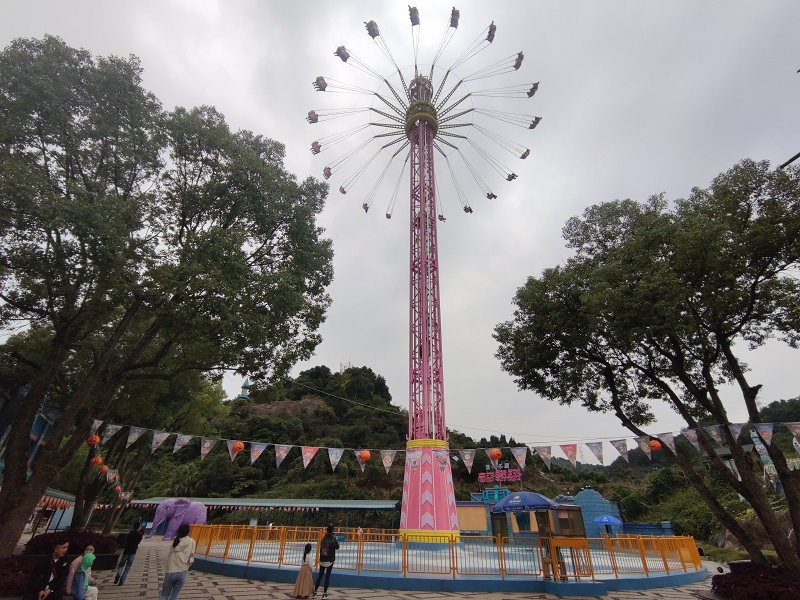
1. What “Landmark” Means for a Park That Does Not Exist Yet
For an established park, a landmark is a marketing asset. For a new park it is also a planning tool: a vertical reference that anchors the master plan, defines the skyline, and gives the first phase a visible identity before the rest of the park is built.
That means the tower has to be chosen early, not added after the layout is fixed. Its position determines sightlines, circulation, the position of the entrance plaza and even the orientation of the car park.
2. Why a Tower Is Often the First Iconic Ride
Three properties make a tower attractive as a first landmark. It is highly visible from outside the site, it carries a large number of passengers per hour for its footprint, and it can be delivered and commissioned faster than a heavily themed dark ride or a coaster that requires extensive track and structure work.
A swing chair tower also scales well: the same design family can be specified at different heights to match a master plan that will grow in phases, which keeps the engineering familiar as the park expands.
3. Visibility Before the Gate Opens
For a new park, visibility is not a luxury. It is how the site announces itself during construction and how the marketing campaign creates anticipation. A 42 m tower can be seen from the approach road, the surrounding neighbourhood and, depending on the terrain, from further away.
That visibility has to be checked against planning constraints before the site is finalised. Height limits, protected views and aviation restrictions apply to new parks as much as to existing ones. Confirm what the site can legally support, then choose the height that fits inside that envelope.
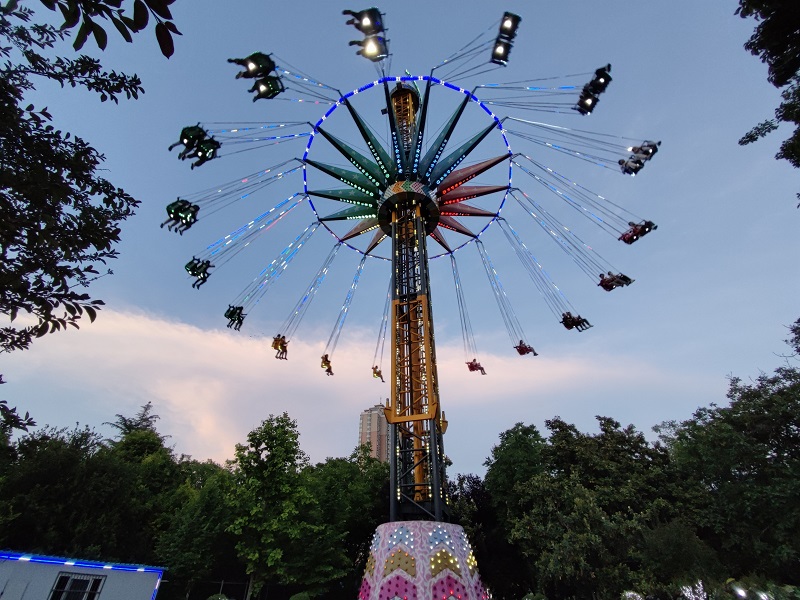
4. Building the Master Plan Around the Tower
The tower should sit at the centre of a sightline that runs from the entrance through the main plaza. Guests should see it as they arrive, and the path to it should pass through the park’s commercial and food areas rather than around them.
Its footprint of about 25 m in diameter, plus swing clearance and queue space, has to be reserved in the master plan even if the ride is installed in a later phase. Reserving the plot costs nothing; retrofitting it after the surrounding attractions are built can be impossible.
5. The Phasing Argument
New parks rarely open complete. Most open with a first phase and add attractions as attendance grows. A tower suits that model because it delivers a strong visual identity in phase one without consuming the space or the capital of a major themed area.
The planning task is to make sure the first phase does not block the second. Leave access roads, utility corridors and expansion plots in the master plan, and position the tower so that later rides can be built around it rather than in front of it.
6. Marketing: One Image That Explains the Park
A new park needs an image that can be used in a brochure, a website header and a press release before any guest has visited. A tower with lighting gives that image a distinctive silhouette, and the photograph can be taken during construction to show progress.
For investors, the same image serves a different purpose: it demonstrates that the park has a physical identity rather than a collection of rides. That matters in the early stages, when the project is competing for attention and finance.
7. What a Tower Cannot Do
A tower is not a substitute for a full attraction lineup. It is a short-duration experience, it does not create the immersive world that a themed land provides, and it will not by itself persuade a family to spend a full day on site. New parks still need family rides, food, shade, toilets and a reason to stay.
It is also not a cheap option if the site requires a difficult foundation or a long season of wind closures. Those conditions can turn a landmark into a liability, which is why the site assessment comes before the order.
8. A Decision Framework for New Parks
- Can the site legally support a 42 m structure in the planned position?
- Is the tower visible from the approach road and the entrance?
- Does the master plan reserve the footprint, clearance and queue area?
- Is the first-phase budget sufficient for the ride plus its foundation and infrastructure?
- Will the ride still make sense when the park adds its second and third phases?
- Is there a credible attendance forecast that supports the tower’s operating cost?
If the answers are yes, the tower is a reasonable first landmark. If two or three are no, the park should probably open with a different anchor attraction and add the tower later.
9. Working With the Manufacturer From the Start
Involve the manufacturer before the master plan is fixed. Foundation loads, crane requirements, electrical demand and delivery access all influence where the ride can sit, and changing them after the plan is drawn is expensive.
An observation swing chair ride from a manufacturer that has worked on new-build parks will come with the site-planning inputs the design team needs. A tower ride by Dinis is normally quoted with foundation data, electrical load schedules and installation drawings, which lets the master plan be drawn around real numbers. Dinis has supplied tower rides, ferris wheels, swing chairs and complete park equipment packages from Zhengzhou, China for more than twenty years, and works with developers from the concept stage through to commissioning.
The structure is fabricated from steel, and the base reactions depend on the final height, seat count and options. That is why the manufacturer should see the master plan, not just a request for a price. As an amusement park equipment maker, Dinis can prepare a configuration that fits the phase-one plan and still leaves room to grow.
Current project reference: https://www.dinisdreammyland.com/products/42-m-sky-flyer-ride-for-sale/